
In many industrial duct systems, fabric expansion joints are specified using a familiar checklist. Engineers check the temperature rating, check the face dimensions, and select the type of connection that matches the ductwork. The listed parameters are adequate for selecting and procuring the material.
However, expansion joints are not simple material parts. Instead, they are composed of multi-layer composites, where each layer has a specific function. The durability of the joint depends on how those layers interact under operating conditions. When internal construction does not match the process environment, a joint that meets external specifications may still degrade early in service.
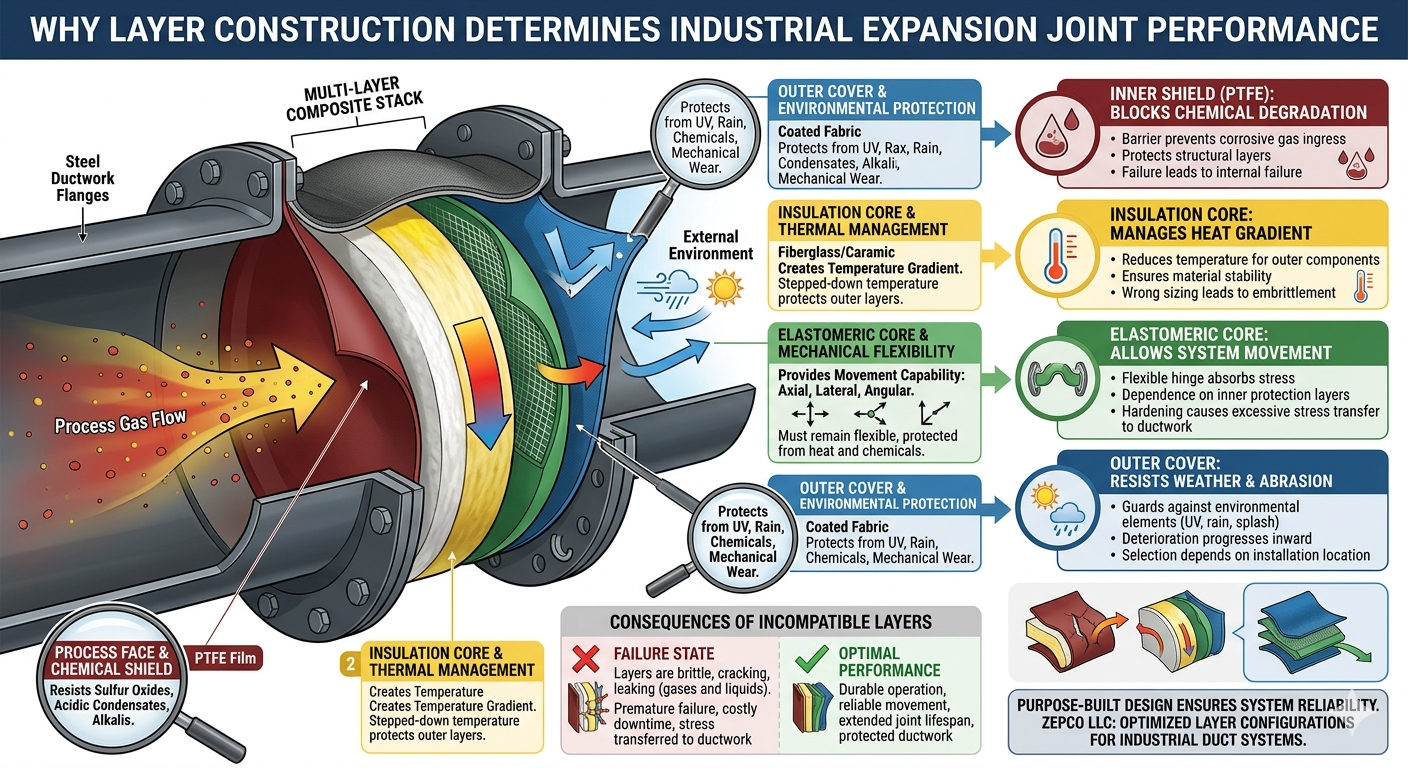
Process engineers often understand the thermal and chemical conditions inside their systems. What receives less attention is how expansion joint layer sequencing influences those conditions as they move through the joint structure. A clear understanding of that sequence helps prevent early failure and improves system reliability.
Why Do Expansion Joints With Similar Ratings Perform Differently?
Two expansion joints could have the same dimensions and temperature ratings during specification. The surface could appear equally suitable during the assessment. However, their performance after installation differs from what it was during assessment. The design of the inner layer causes this difference in durability and stability.
Each layer of the expansion joint impacts the environment that the subsequent layer receives. Heat flows gradually throughout the entire structure. The flow of chemicals could be gradual or restricted within the structure. Flexibility is achieved by protecting the mechanical core from stress and temperature changes through the inner layer. The sequence of the inner layer is necessary for consistent operation.
Process Face Layer And Chemical Protection
The innermost surface of an expansion joint contacts the process gas stream. This layer must tolerate both temperature and chemical exposure. In many industrial systems, the barrier material is PTFE film, also known as polytetrafluoroethylene.
PTFE functions as a chemical shield. The gases passing through the ducts in power generation and chemical processing can contain compounds that can degrade materials over time.
The contaminants that can be expected:
- Sulfur oxides that result from combustion processes
- Acidic condensates that result from cooling cycles
- Alkali particles that result from ash-laden gases
- Hydrocarbon vapors and chemical byproducts
Fiberglass fabrics and insulation materials do not withstand continuous exposure to chemicals. Their service life depends on the barrier layer that prevents these compounds from reaching the structural layers.
If the barrier material does not match the gas chemistry, degradation begins within the internal stack. Surface inspection may reveal little damage, while insulation and reinforcement materials gradually weaken.
This is why chemical compatibility must be evaluated during the specification of an expansion joint. Temperature classification alone cannot predict service life.
Insulation Core And Thermal Management
In an expansion joint assembly, the insulation core controls how heat flows through the structure. The purpose of which is to maintain a controlled temperature gradient between the process stream and the external mechanical layers. Most fabric expansion joints use fiberglass or ceramic fiber insulation, depending on system temperature and the degree of heat reduction required across the cross-section. Correct insulation sizing supports a temperature environment that allows outer materials to remain flexible and stable during operation.
Heat exposure over time leads to several material changes:
- Hardening of elastomeric layers
- Loss of flexibility
- Surface cracking
- Reduced movement capability
These changes develop gradually during operation. Careful insulation design prevents those temperature shifts and helps maintain long-term performance.
Elastomeric Core And Movement Capability
Where Does Expansion Joint Flexibility Come From?
The elastomeric layer serves as the mechanical core of the expansion joint. This component allows the assembly to absorb movement within the duct system.
Movement accommodation may include:
- Axial compression and extension from thermal expansion
- Lateral displacement caused by structural shifts
- Angular deflection during system operation
The elastomer behaves as a flexible hinge embedded within the joint structure.
Its performance depends on two protective conditions. The insulation layer must limit heat exposure, and the inner barrier must prevent chemical attack.
When either protective layer fails to perform its role, the elastomeric material begins to change properties. Hardening, swelling, or delamination may occur. Flexibility decreases, and the joint loses its ability to absorb system movement.
Ductwork then carries stresses that the joint was designed to manage.
Outer Cover And Environmental Protection
Why External Conditions Matter
The external cover will protect against environmental exposure. Most expansion joints are exposed to the elements in outdoor and industrial settings, where equipment is exposed to solar and nuclear radiation, as well as mechanical wear and tear.
The elements that could cause exposure are:
- Rain and moisture
- Ultraviolet light
- Chemical splash from nearby equipment
- Mechanical wear and tear during maintenance
- High ambient temperature from nearby equipment
If the outer layer lacks environmental resistance, deterioration begins on the exterior surface. Cracking and fabric breakdown allow environmental exposure to reach the structural layers beneath.
In this case, degradation progresses from the outside inward.
Environmental conditions, therefore, influence the selection of the outer cover during system design. Installation location matters as much as process conditions.
Why Layer Sequencing Matters In Joint Design
An expansion joint functions as a coordinated system of materials. Each layer influences the operating conditions experienced by the next layer in the stack.
Individual material ratings provide helpful guidance. Performance still depends on how those materials interact under the same temperature and chemical exposure.
For this reason, engineering teams often analyze the internal stack using a sequential approach:
- Identify process gas chemistry and operating temperature
- Select a barrier material compatible with the gas stream
- Size insulation layers to manage thermal transfer
- Choose elastomeric materials that remain flexible within that environment
- Specify an outer cover suitable for environmental exposure
This inside-out design method allows each layer to operate within its intended limits.
Manufacturers with specialized experience follow similar procedures. Zepco LLC develops fabric expansion joints by first reviewing system parameters and then designing the layer construction to match the installation conditions. This process supports long-term performance in industrial duct systems where standard configurations may not align with operating conditions.
Fabric Expansion Joints: Purpose-Built Design and System Reliability
Across many production facilities, procurement teams depend on standard product specifications to streamline purchasing decisions. Expansion joints benefit from a detailed engineering assessment because internal construction influences the way systems operate over time.
A standard configuration may align with operating conditions in several installations. A purpose-designed assembly supports dependable operation when chemical exposure, temperature variation, and surrounding environmental conditions differ within the system.
Through careful engineering review, internal layers can be assessed for durability and compatibility with duct system demands. This process ensures the proper functioning of fabric expansion joints during their lifespan. Uniform performance is also promoted by considering operating conditions during material selection and design. For further guidance, facilities may contact reliable manufacturers, such as Zepco LLC, for advice on operating conditions and parameters for specific applications.