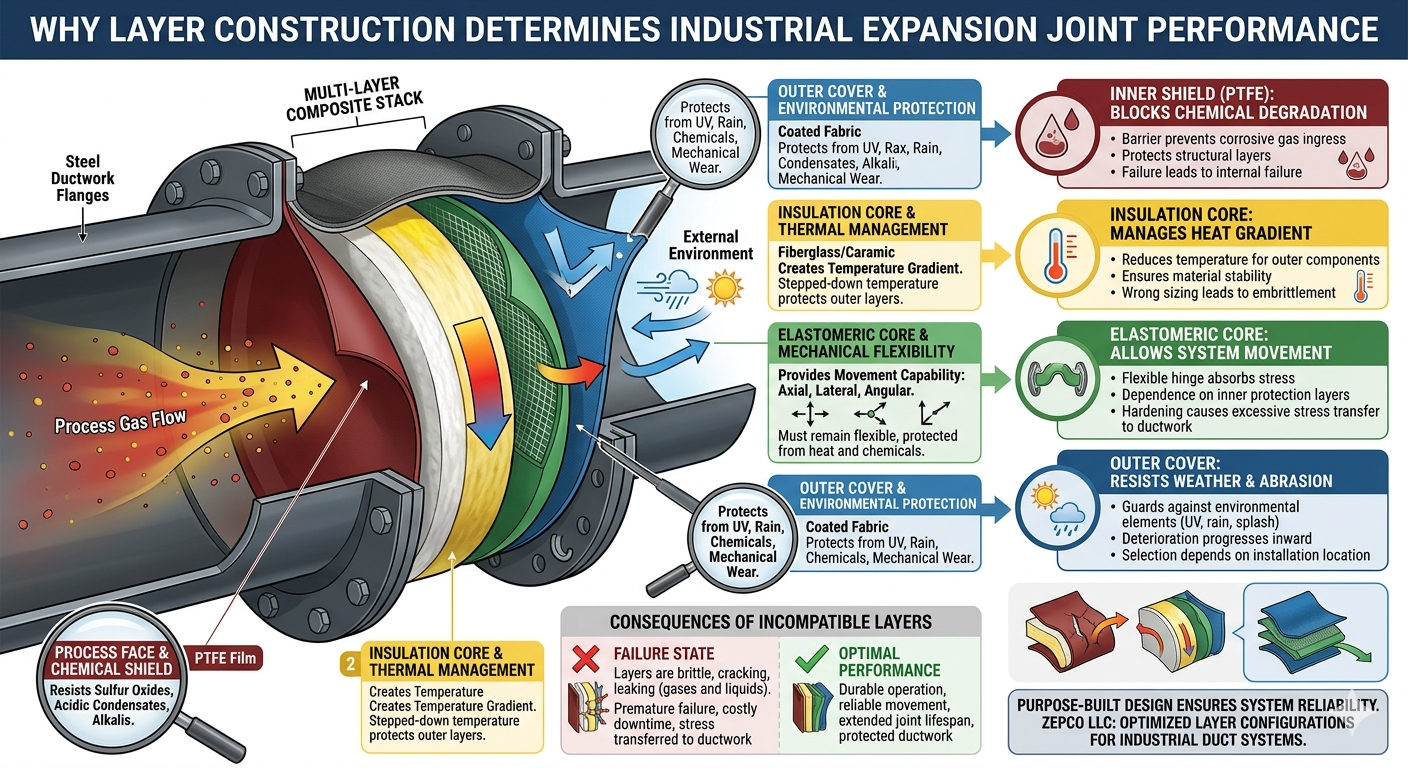
HRSG Expansion Joints: Preventing Catastrophic Failures in Heat Recovery Steam Generators

HRSG expansion joints face extreme conditions that challenge the durability of conventional boiler components. During rapid startups, combined cycle plants experience temperature swings exceeding 1,000°F within minutes, placing intense stress on HRSG systems. Zepco LLC specializes in engineering expansion joints that endure these cycles, ensuring reliable performance under continuous, high-temperature operations.

Daily operations for combined cycle plant engineers, maintenance teams, and HRSG specialists involve repeated thermal cycling that tests system integrity. Standard expansion joints can struggle under these conditions, making custom HRSG solutions essential for long-term reliability. By addressing precise thermal, mechanical, and dimensional requirements, Zepco LLC supports uninterrupted performance and reduces the risk of unexpected failures.

HRSG Operational Stressors and Unique Requirements

HRSG operations differ significantly from conventional boilers. Startups are rapid, shutdowns happen quickly, and load-following cycles respond to grid demands. Temperature stratification, pressure pulsations from gas turbine exhaust, and flow-related vibrations all contribute to stress levels that standard boiler expansion joints were not designed to handle.

Thermal Cycling Frequency and Impact

Conventional boilers increase temperature gradually over several hours and operate steadily for long periods with 10 to 20 cycles annually. HRSGs experience rapid temperature ramps within 20 to 45 minutes, with multiple startups and shutdowns each day and 50 to 200 cycles annually. Temperature swings exceeding 1,000°F cause significant duct expansion and movement in the expansion joints. This repeated cycling quickly accumulates fatigue in materials and connections.

Temperature Stratification and Hot Spot Effects

Exhaust gases rise to the top of HRSG ducts while cooler gases remain near the bottom, creating temperature differences of 200 to 300°F across a single expansion joint. This uneven heating produces localized stress and accelerates material wear. Hot spots in the upper sections of ducts require materials that maintain strength and flexibility across varying temperatures.

Gas Turbine Exhaust Influence

HRSGs experience pressure pulsations linked to turbine rotation and combustion dynamics. Pulsations, combined with exhaust velocities of 150 to 250 ft per second, create vibratory stress on expansion joint frames and attachments. Oxygen-rich exhaust increases the potential for corrosion and fatigue. Materials and designs that address these factors ensure reliable operation.

Operational Flexibility and Load Following

Grid demands drive rapid startups and load-following operations, and expansion joints must accommodate these cycles while maintaining integrity. Engineering and materials are designed to match operational patterns and maintain performance across repeated thermal cycles.

Predictable HRSG Expansion Joint Failure Modes

Expansion joint failures follow recognizable patterns based on operational stress. Understanding these modes allows for proactive monitoring and replacement.

Thermal Cycling Fatigue 

Occurs as repeated expansion and contraction stress fabric coatings, metal frames, and attachment points. Failures that would take many years in conventional service occur in only a few years in HRSG service. Warning signs include visible cracks, rust stains, and loose fasteners.

Hot Spot Degradation 

Results from localized high temperatures due to stratification. Materials in upper sections may experience accelerated oxidation or coating breakdown. Discoloration, localized brittleness, and signs revealed by thermal imaging indicate areas that require attention.

Vibration and Pulsation Effects 

Cause loosening of fasteners, frame cracking, and fabric abrasion. Pressure pulsations create cyclic stress that requires vibration-resistant designs. Audible vibrations and wear marks serve as indicators of developing issues.

Rapid Thermal Shock Cracking 

Arises from fast startups that induce thermal gradients in materials. Outer layers heat and cool faster than inner layers, generating stress that can lead to cracking or delamination. These occurrences can be identified through surface patterns and material degradation in multi-layer constructions.

Engineering HRSG-Specific Expansion Joints

Conventional expansion joints cannot sustain HRSG operational demands. HRSG expansion joints are designed with specific requirements to endure thermal cycling, temperature stratification, vibrations, and rapid ramps.

  1. Cycle Life: Components are engineered for 30,000 to 50,000 cycles to match daily load-following operations.
  2. Temperature Stratification Accommodation: Materials maintain performance under the highest localized temperatures, supported by multi-layer construction and integrated insulation.
  3. Vibration and Pulsation Resistance: Frames and fasteners are constructed to absorb and resist gas turbine-induced forces.
  4. Rapid Thermal Ramp Capability: Materials and coatings maintain integrity during swift heating and cooling to prevent delamination and cracking.
  5. Inspection Readiness: Designs allow for rapid assessment during scheduled maintenance and extend intervals between inspections without compromising safety.

These specifications ensure reliable performance and reduce unplanned downtime, supporting operational continuity.

Zepco LLC Expertise in HRSG Expansion Joints

Zepco LLC specializes in expansion joints engineered for combined cycle operations. The team integrates knowledge of gas turbine exhaust patterns, thermal cycling, and load-following schedules to design custom solutions.

Materials are selected for high-cycle performance, temperature resilience, and corrosion resistance. Multi-layer designs and robust frame constructions provide flexibility and strength, ensuring long-term reliability.

Emergency support is available to address urgent HRSG needs, minimizing the cost and impact of operational interruptions. Engineering services include operational pattern analysis, inspection during planned outages, failure root cause assessment, and scheduling proactive replacements.

Reliable Performance through Tailored Engineering

HRSG expansion joints encounter operational conditions that challenge standard equipment. Rapid thermal cycling, temperature differences within ducts, pulsating exhaust, and daily load-following cycles all influence material performance. Effective solutions rely on engineering that aligns with HRSG service requirements, ensuring expansion joints remain reliable throughout their operational life.

Zepco LLC provides HRSG expansion joints that accommodate combined cycle conditions, enabling power plants to maintain consistent performance. These joints offer long-term reliability and ease of maintenance, supporting daily operations and protecting plant assets. Facilities gain confidence that their expansion joints withstand operational demands, reduce downtime, and optimize performance.

Contact Zepco LLC to discuss HRSG expansion joint requirements and solutions engineered for combined cycle applications.


Insights from ZEPCO: How Steam Expansion Joints Maintain Safety in High-Pressure Systems

Walking through an industrial steam facility reveals impressive equipment: massive boilers, turbines, and intricate piping networks. What often goes unnoticed are the components maintaining system integrity. Steam expansion joints accommodate forces that would otherwise stress piping and equipment, converting thermal movement into controlled, safe displacement. 

These components are essential for operational reliability and preventing costly failures. ZEPCO LLC’s extensive experience highlights that expansion joints serve as integral safeguards for high-pressure steam systems.

Expansion joints function as engineered systems that maintain safety, absorb thermal stress, and protect critical machinery, all while blending seamlessly into the overall design of the facility. Engineers overseeing power generation, industrial operations, or facility maintenance depend on these components to ensure consistent system performance.

Forces Generated by Steam Systems

High-pressure steam systems operate under extreme conditions. When piping heats from ambient conditions to operational temperatures between 400°F and over 1000°F, significant expansion occurs. Properly designed steam expansion joints absorb these forces, preventing stress from reaching connected equipment.

Thermal Expansion Dynamics

  • Ambient installation temperature: 70°F typical
  • Operating steam temperature: 400°F–1000°F+
  • Temperature differential: 330°F–930°F+
  • Startup/shutdown cycles: Repeated thermal changes

Steel piping expands approximately 0.78 inches per 100 feet per 100°F rise. For a 200-foot line operating at 600°F, linear expansion reaches 8.25 inches. Without flexible accommodation, forces concentrate on joints, anchors, and connected equipment.

Potential Equipment and Piping Impacts

  • Equipment Connections: Boilers, turbines, and pumps experience strain during thermal growth.
  • Piping Systems: Welded joints and long pipe runs adjust through flexible movement rather than rigid constraint.
  • Anchor Points: Supports and foundations are designed to handle pressure and weight, with expansion joints managing thermal forces.
  • Secondary Equipment: Valves, instrumentation, and insulation systems remain protected through stress absorption by expansion joints.

Engineering calculations show that managing thermal expansion through proper design ensures system longevity and operational stability. Expansion joints convert forces that would otherwise affect equipment into controlled motion, enhancing reliability throughout the facility.

How Steam Expansion Joints Work

Steam expansion joints absorb thermal and mechanical movements in piping systems to prevent stress and maintain seal integrity. They accommodate axial compression/extension, lateral offsets, and angular rotation using bellows or multi-layer fabric designs. 

These joints flex to handle thermal expansion, minor misalignments, and foundation settling while supporting thousands of operational cycles.

Movement Absorption

  • Axial Compression/Extension: Bellows or fabric construction accommodates linear movement along the pipe axis. Corrugated metal bellows deform elastically, while multi-layer fabrics flex to absorb thermal expansion. Movement capacities typically range from 1–6 inches with thousands of cycles supported depending on design.
  • Lateral Offset Capability: Multi-bellows or fabric designs allow perpendicular movement, addressing thermal bowing in long pipe runs and settling of foundations.
  • Angular Rotation: Expansion joints handle minor misalignments, maintaining seal integrity and reducing stress concentrations during operation.

Stress Isolation Effect

Expansion joints direct thermal forces into movement, keeping connected equipment and anchor points free from excessive stress. Pressure containment remains intact, allowing systems to operate efficiently and safely. These components ensure that thermal expansion is managed without affecting operational performance or equipment integrity.

Key Specification Factors for High-Pressure Steam Systems

For high-pressure steam systems, specifying pressure rating, temperature capability, movement, and material selection is essential for reliable operation. Considering cycle life, steam quality, environment, and maintenance access ensures long-term safety, efficiency, and durability of expansion joints.

Pressure Rating

Design pressure should exceed operating pressure, with ASME standards recommending at least 1.5 times operating pressure. Bellows and fabric designs must accommodate pressure fluctuations during startup and operational changes.

Temperature Capability

Material selection is critical for reliable service:

  • Metallic bellows: Stainless steel grades provide corrosion resistance and high-temperature strength.
  • Fabric joints: High-temperature fabrics like ceramic or high-silica glass withstand extreme steam conditions.
  • Insulation integration supports material longevity and system efficiency.

Movement Calculations

Precise thermal expansion assessment is required:

  • Accurate pipe length between anchors
  • Operational temperature ranges
  • Startup/shutdown cycles
  • Equipment thermal growth

Cycle Life Requirements

Daily operations and frequent startups affect component longevity. Expansion joints are designed for extended service life, factoring in material performance and operational cycles.

Application-Specific Considerations

  • Steam quality: Wet steam requires drainage provisions; chemical treatments affect material selection.
  • Installation environment: Indoor vs. outdoor, vibration, and seismic considerations.
  • Accessibility for inspection and maintenance ensures ongoing reliability.

Proper specifications ensure steam expansion joints operate reliably in high-pressure environments, enhancing system safety and performance.

Preventive Maintenance Practices

Preventive maintenance for expansion joints includes visual inspections, performance monitoring, and tracking replacement schedules to ensure reliable operation. Maintaining critical spares and up-to-date specifications enables rapid response and minimizes unplanned downtime. 


Regular, scheduled maintenance protects high-pressure systems and extends component service life.

Visual Inspection

  • Check for corrosion patterns or insulation damage.
  • Assess mechanical integrity and anchor condition.
  • Inspect supports for stress signs.

Performance Monitoring

  • Observe for minor leaks or unusual noise during thermal cycles.
  • Evaluate vibration patterns through connected piping.
  • Monitor downstream equipment for stress indicators.

Replacement Strategy

  • Track installation dates and cycle counts.
  • Plan replacements during scheduled outages.
  • Maintain up-to-date specifications for rapid procurement.

Critical Spares

Maintain spares for key locations:

  • Document specifications.
  • Pre-order long-lead items.
  • Verify components meet current operational requirements.
  • Maintain emergency supplier contacts for rapid response.

Scheduled maintenance ensures expansion joints continue to perform effectively, protecting high-pressure systems and reducing unplanned downtime.

ZEPCO’s Expertise in Steam Systems

ZEPCO LLC provides comprehensive support for high-pressure steam systems. Services include:

  • Thermal expansion analysis and calculation
  • Material selection guidance for specific steam conditions
  • Cycle life assessment and component optimization
  • Customized expansion joint design for unique applications
  • Installation configuration and integration consultation
  • Rapid-response support for critical system needs

Working with ZEPCO ensures steam expansion joints perform optimally, enhancing system reliability, protecting equipment, and supporting operational continuity.

Engineering Safety with Expansion Joints

Thermal expansion is a constant in steam systems. Steam expansion joints manage these forces efficiently, protecting equipment, supporting reliability, and maintaining safe operation. ZEPCO LLC offers expertise, manufacturing capability, and responsive support to ensure high-pressure steam systems function effectively.

Contact ZEPCO’s engineering team for consultation, specification guidance, or emergency response. Properly specified and maintained expansion joints are essential components that preserve system performance and protect valuable assets.


24 Hour Expansion Joint Replacement: ZEPCO’s Round-the-Clock Industrial Service Excellence

Industrial operations don’t stop for emergencies. When a critical component fails, every minute matters. Downtime translates into lost revenue, safety concerns, and strained production schedules. Expansion joints—those essential components that absorb thermal movement, vibration, and pressure—are often unsung heroes until they fail. At that moment, plant operators and engineers quickly realize the urgency of securing a 24 hour expansion joint replacement service they can trust. This is where ZEPCO LLC stands as a dependable partner, delivering speed, precision, and reliability when industries need it most.

Expansion Joint Emergencies: Critical Challenges Explored

When an expansion joint reaches failure, the ripple effects across a facility can be severe. A compromised joint may lead to equipment misalignment, leaks, or even dangerous safety hazards. For power plants, chemical facilities, or refineries, the consequences often include halted operations, missed production deadlines, and higher risks of noncompliance with safety regulations. In these moments, immediate repair or replacement is not just preferable—it’s essential. ZEPCO has built its reputation around providing urgent, high-quality solutions, ensuring that 24 hour expansion joint replacement services keep plants safe, stable, and operational under pressure.

Why Time Matters in Industrial Repairs

Every hour of downtime costs money. Lost production hours pile up into six-figure financial setbacks, operational schedules get disrupted, and compliance officers may flag safety concerns if repairs aren’t handled quickly. For plant managers and maintenance supervisors, this pressure creates a simple equation: fast response equals minimized losses. ZEPCO’s 24 hour expansion joint replacement model is designed to cut this downtime dramatically. With rapid mobilization, expert crews, and years of specialized industrial experience, ZEPCO helps facilities weather emergencies with resilience—keeping performance levels high even in the most challenging situations.

ZEPCO’s Service Excellence: Speed and Quality Combined

ZEPCO doesn’t just show up quickly; it delivers dependable results under the toughest conditions. The company’s emergency service model is built on three pillars:

  • Immediate assessment and dispatch. As soon as a call comes in, ZEPCO coordinates logistics and dispatches experienced teams to the site.
  • Expert installation of premium components. Every expansion joint used is manufactured to meet or exceed demanding industrial standards, ensuring durability and precision.
  • Reliable performance under pressure. Even in emergency settings, ZEPCO guarantees the same level of workmanship, quality assurance, and safety compliance that clients expect during scheduled maintenance.

This blend of speed and expertise is what makes ZEPCO a trusted leader in 24 hour expansion joint replacement, no matter the scale or complexity of the industrial system.

Industries Relying on ZEPCO’s Rapid Solutions

The demand for round-the-clock replacement services cuts across industries. Power generation plants rely on ZEPCO to avoid costly outages. Chemical processing facilities depend on immediate solutions to maintain safety and compliance. Oil and gas refineries, with their high-pressure, high-temperature systems, count on ZEPCO’s technical precision. Manufacturing lines and wastewater treatment facilities also benefit from ZEPCO’s ability to adapt its expertise to diverse environments. By offering 24 hour expansion joint replacement, ZEPCO proves its ability to serve a wide spectrum of industrial operations, each with unique technical and regulatory requirements.

Key Benefits of Choosing ZEPCO

Partnering with ZEPCO for emergency expansion joint services delivers clear, measurable advantages:

  • Reduced downtime and minimized financial losses. Rapid response keeps production lines moving.
  • Protection of critical systems and assets. High-quality replacement joints prevent further damage.
  • Confidence in safety compliance. ZEPCO ensures that every replacement meets regulatory standards.
  • Trusted professionals under pressure. Skilled teams bring experience and assurance, even in the most urgent cases.

For facility operators, the real value lies in peace of mind—knowing that a proven partner is available 24/7 to protect uptime and keep operations secure.

Your Partner for Industrial Uptime

In a world where every minute counts, ZEPCO stands out as more than a service provider—it’s a strategic partner. Its 24 hour expansion joint replacement services embody the qualities industrial leaders need: reliability, expertise, and unwavering commitment to performance. Whether it’s midnight in a refinery or early morning at a power plant, ZEPCO delivers solutions that restore safety, efficiency, and operational flow without compromise.

For plant managers, maintenance supervisors, and industrial engineers, the message is clear: when emergencies strike, ZEPCO is ready. Contact ZEPCO LLC today for dependable emergency expansion joint replacement services and ensure your facility stays ahead of downtime.


Expansion Joint for Steam Piping Sizing Guide: The 5-Step Method That Eliminates Costly Installation Errors

A two-inch mistake doesn’t sound catastrophic—until it shuts down a 400-psig steam system, costs $340,000 in emergency repairs, and halts production for 72 hours. Unfortunately, this isn’t an isolated incident. Industry data shows that 78 percent of steam expansion joint failures can be traced back to incorrect initial sizing. The reality is clear: getting the expansion joint for steam piping right from the start isn’t optional—it’s mission-critical.

That’s why Zepco developed a systematic, five-step methodology designed to eliminate the guesswork that plagues traditional “rule-of-thumb” sizing. For piping engineers, plant managers, and mechanical designers, this approach transforms a high-risk calculation into a defensible, precise engineering process that prevents costly installation errors.

Step 1: Calculate Thermal Movement with Precision

Steam is dynamic—it moves, cycles, and expands under conditions ranging from 212°F to well over 1000°F. Accurately sizing an expansion joint for steam piping starts with quantifying that thermal growth. Using the fundamental equation (ΔL = α × L × ΔT), engineers calculate exact linear movement. But accuracy requires more than plugging numbers into a formula.

Neglecting real-world factors—installation temperature, fixed support effects, or multi-directional vectors—creates blind spots. Zepco’s engineers integrate computer-aided FEA checks with EJMA and ASME verification to ensure the thermal movement analysis is bulletproof, not just theoretical.

Step 2: Analyze Pressure to Define Structural Integrity

Steam pressure isn’t static—it cycles, surges, and stresses every convolution of an expansion joint. Correct sizing means evaluating not only operating and design pressures but also emergency relief loads and hydrostatic testing conditions.

An underdesigned joint risks catastrophic rupture; an oversized one creates unnecessary pressure thrust loads on piping anchors. Zepco’s methodology ensures each expansion joint for steam piping is structurally optimized—balancing bellows thickness, convolution geometry, and reinforcement to handle real-world loads.

Step 3: Select the Right Material for Steam Conditions

Material choice is where engineering meets reality. Carbon steel may be cost-effective, but it’s vulnerable in high-temperature cycling. Stainless steel offers reliability up to 800°F, while Inconel and Hastelloy excel in extreme thermal and corrosive environments.

Zepco’s engineers evaluate service life expectations, condensate chemistry, and fatigue cycles to specify the ideal material. This eliminates the common mistake of defaulting to “standard” alloys that fail under demanding steam service. In many cases, fabric or composite materials with ceramic layering offer superior performance when traditional metals can’t keep up.

Step 4: Engineer the Configuration, Not Just the Component

Even the best expansion joint fails if it’s placed incorrectly. System configuration—anchor points, guide spacing, condensate drainage, and insulation—must integrate with the joint. Universal and gimbal configurations often outperform single joints in complex routing, while pressure-balanced systems prevent thrust overloads.

By analyzing support systems and accessibility needs, Zepco ensures every expansion joint for steam piping is not only the right size but also the right fit for its operating environment. This holistic design approach is what prevents stress concentrations, vibration issues, and premature fatigue.

Step 5: Verify and Validate Before Installation

Sizing errors are expensive. That’s why Zepco closes the loop with rigorous validation—peer reviews, code compliance checks, and manufacturer verification. Every calculation package includes documented assumptions, unit consistency checks, and configuration drawings that meet professional engineering standards.

This final step transforms theoretical sizing into practical certainty. It’s the difference between a $125,000 emergency replacement and decades of reliable service.

Why Zepco’s Method Matters

Steam system engineers can’t afford shortcuts. A single miscalculation ripples through operations, causing downtime, lost revenue, and safety risks. Zepco’s expansion joint for steam piping methodology is designed to prevent those outcomes—delivering precise, code-compliant solutions that engineers can defend with confidence.

With decades of field-proven experience, Zepco provides more than just products; we provide engineering assurance. From initial calculations to installation support, our team ensures your steam systems perform reliably, efficiently, and without costly surprises.

Eliminate the Guesswork

Steam piping is unforgiving, but sizing doesn’t have to be. By following Zepco’s 5-step methodology—thermal analysis, pressure evaluation, material selection, configuration design, and final validation—engineers can eliminate the errors that cause 78 percent of failures.

The result? Expansion joints that last, systems that run, and budgets that stay intact. When it comes to sizing an expansion joint for steam piping, precision isn’t just good engineering—it’s good business.


FD Fan Expansion Joints: The Critical Component That Prevents Costly Forced Draft Fan Failures in Power Plants

In every power plant, there’s a silent guardian working behind the scenes—often unnoticed, yet absolutely essential. We’re talking about FD fan expansion joints, and if you’re a power plant engineer, maintenance lead, or operations manager, ignoring them isn’t an option—it’s an invitation to disaster.

At Zepco LLC, we don’t just design expansion joints—we engineer critical protection systems. And when it comes to forced draft fans, we understand the reality: a $15,000 joint is often the only thing standing between smooth combustion air flow and a multi-million-dollar failure.

The Hidden Hero in Your Combustion Air System

Forced draft (FD) fan systems are the lifeblood of combustion in coal-fired, gas-fired, and biomass plants. They feed the boiler, regulate emissions, and must operate with 99%+ availability. But within that system is an often-overlooked component—the FD fan expansion joint. This is where airflow meets brutal heat, corrosive byproducts, and constant vibration. You might not see it fail—until your ductwork cracks, your fan bearings seize, and you’re staring down a three-week outage and a $1.2 million replacement.

Why FD Fan Expansion Joints Aren’t Just “Maintenance Items”

Let’s be blunt. These joints aren’t optional extras. They’re engineered to absorb thermal growth, isolate vibration, maintain seal integrity, and relieve stress that would otherwise destroy your ducting and fan. Think about it—ambient air enters the system and is pushed through ductwork reaching 800°F or more. That kind of temperature fluctuation causes duct movement, vibration, and fatigue. Without the right FD fan expansion joints in place, that movement becomes destruction.

At Zepco, we view FD fan expansion joints as the invisible shield of your plant’s reliability. They’re not just components—they’re protection protocols in flexible form.

What Happens When FD Fan Expansion Joints Fail?

Failure isn’t subtle. It doesn’t whisper—it roars. It starts with hairline cracks in ductwork, unexpected vibration spikes, and air leaks that sap efficiency. Then your fan starts vibrating out of spec. Shaft alignment goes. Bearings overheat. Eventually, the entire forced draft system is compromised.

Let’s do the math:

  • Expansion joint replacement cost: $25,000
  • FD fan failure and unplanned outage: $2.5M fan + $85K/day in downtime

Now consider this: Zepco expansion joints are designed to last 8-12 years under thermal cycling, high particulate exposure, and corrosive gases. That’s not just ROI—it’s insurance for your uptime.

The Engineering Behind the Protection

Zepco’s FD fan expansion joints aren’t off-the-shelf. They’re purpose-built for plant-specific conditions. Every solution accounts for:

  • Multi-directional thermal expansion
  • Abrasive fly ash and sulfur compounds
  • Constant vibration and startup shocks
  • Pressure differentials and seal integrity

Materials matter too. We use high-temp fabrics, ceramic insulation, fluoropolymer coatings, and metallic reinforcements—all layered into composite systems with tested thermal and chemical resistance. These aren’t just designed to work—they’re designed not to fail.

Seamless Integration Into Critical Systems

FD fan expansion joints are mission-critical to everything downstream: boiler combustion, emissions control, plant efficiency, and safety systems. A failing joint? It doesn’t just cause a leak. It derails combustion balance, risks emission compliance, and sets off safety protocols.

That’s why Zepco doesn’t just ship product. We provide installation guidance, commissioning support, and predictive maintenance strategies—because we understand that an expansion joint doesn’t live in isolation; it lives in the pulse of your plant.

Maintenance That Pays for Itself

Predictive maintenance isn’t a buzzword—it’s a necessity. Zepco offers expansion joints with integrated monitoring points and visual inspection access, so you can catch degradation before it becomes downtime. Our joints are built to withstand thermal fatigue, but they’re also engineered for inspection, planning, and easy replacement during scheduled outages, not emergencies.

Why Zepco?

Because at Zepco, we specialize in protecting critical plant components with unmatched speed, precision, and insight. From custom application engineering to field support and material testing, we know what it takes to keep FD fan expansion joints operating like the unsung heroes they are.

If you’re still thinking of expansion joints as accessories, it’s time to shift your perspective—and your priorities. Your FD fan deserves a partner, not a patch.

Ready to Fortify Your Forced Draft System?

Trust Zepco to deliver expansion joint solutions that protect $2.5 million in fan equipment and eliminate the risk of catastrophic failures. Because when your entire plant relies on consistent airflow, there’s no room for failure—and no substitute for Zepco-engineered FD fan expansion joints.

Contact our power plant specialists today for a customized solution that guarantees uptime, protects your assets, and keeps your plant at peak performance.

Let Zepco be your plant’s invisible guardian. Because the best failures are the ones that never happen.


High Temperature Expansion Joint Material Breakthrough: New Ceramic Composites That Withstand 3000°F+

For decades, the conversation around high temperature expansion joint material was defined by compromise. Engineers across aerospace, steel manufacturing, glass production, and advanced ceramics reluctantly accepted one stubborn reality: 2200°F was the practical ceiling. Beyond that, materials degraded, oxidized, cracked, or simply failed. This wasn’t just a performance limitation—it was a systemic barrier that forced industries into costly maintenance cycles and constrained innovation.

Today, Zepco LLC has changed that narrative. Through pioneering materials science and advanced ceramic composite engineering, the company has broken through the long-assumed 2500°F barrier and achieved something once thought impossible: reliable high temperature expansion joint material capable of continuous operation at 3000°F and beyond.

This isn’t an incremental improvement. It’s a paradigm shift.

Why 3000°F Mattered So Much

In extreme environments—think rocket propulsion systems, hypersonic test chambers, float glass furnaces, or specialty alloy production—failure at the joint level can cascade into catastrophic downtime, safety risks, and millions in lost productivity. The challenge was simple in phrasing but brutal in execution: create an expansion joint material that could hold mechanical integrity, resist oxidation, and maintain flexibility where nearly every known substance disintegrated.

Traditional solutions—graphite, refractory ceramics, and metal alloys—hit a physics wall. Above 2200°F, structural properties collapsed. By 2500°F, even the best designs degraded rapidly.

Zepco’s research team didn’t just push past that limit. They shattered it.

The Science Behind the Breakthrough

The foundation of Zepco’s high temperature expansion joint material lies in a new generation of advanced ceramic composites engineered from the molecular level up.

  • Ceramic Matrix Technology: Reinforced ceramic fibers embedded in a tailored high-temperature matrix provide both flexibility and resilience.
  • Molecular Engineering: Atomic-level control of bonding structures ensures stability where other materials fracture.
  • Thermal Shock Resistance: The composite microstructure has been engineered to survive rapid 500°F/minute temperature swings without cracking.
  • Oxidation and Chemical Inertness: Unlike metals or legacy composites, Zepco’s material remains stable even in aggressive, high-oxygen environments.

Manufacturing matters just as much as composition. Techniques like sol-gel processing, chemical vapor infiltration, and controlled atmosphere sintering ensure density, purity, and precision at every stage. Real-time quality monitoring means each lot delivers consistent ultra-high-temperature performance.

Proving 3000°F+ in the Lab and in the Field

Breakthrough claims are meaningless without validation. Zepco has put its ceramic composites through the gauntlet:

  • 1,000+ hours of continuous exposure at 3000°F with zero degradation.
  • 10,000 thermal cycles from ambient to extreme heat without fracture.
  • Rapid shock testing involving instantaneous 1000°F+ shifts.
  • Aggressive chemical exposure trials, confirming inertness in hostile atmospheres.

Independent customer validation and long-term field installations confirm the same story: this high temperature expansion joint material doesn’t just survive—it thrives under conditions that previously guaranteed failure.

Unlocking New Applications

What does this mean for industries? In a word: freedom.

  • Steel Manufacturing: Expansion joints in electric arc furnaces now operate at 3200°F without frequent replacements.
  • Aerospace & Defense: Hypersonic vehicles and rocket engines finally have joint solutions that match their heat profiles.
  • Glass Production: Float glass furnaces achieve more stable output at higher operating ranges.
  • Advanced Ceramics & Nuclear: Ultra-high temperature production becomes more reliable and cost-effective
  • Next-Gen Energy: Systems from concentrated solar to advanced reactors can scale into new temperature ranges.

By breaking through the old ceiling, Zepco has created space for entirely new industrial processes and design philosophies.

Beyond 3000°F: The Future Path

The most remarkable part of this story? Zepco’s R&D pipeline is already pushing toward 4000°F-capable materials, exploring self-healing ceramics, and integrating smart sensors directly into high temperature expansion joint material for real-time performance monitoring. This isn’t just about fixing yesterday’s problems—it’s about enabling tomorrow’s breakthroughs in space exploration, nuclear fusion, and next-generation transportation.

Zepco LLC: Redefining Materials Science at the Edge of the Possible

Zepco’s ceramic composites are not simply a product—they’re a statement that the barriers we’ve accepted for decades are no longer immovable. With rigorous testing, advanced design, and unmatched expertise, Zepco is setting a new global standard for high temperature expansion joint material performance.

For engineers, scientists, and technical directors who have been told “it can’t be done,” this breakthrough proves otherwise. The 3000°F barrier is gone. And the future just got hotter—in the best possible way.


Quick Turnaround Expansion Joint Replacement: How Zepco Cuts Standard Lead Times from Weeks to Days

There’s a quiet crisis that plant managers, procurement specialists, and project engineers have been living with for decades: the infuriatingly slow wait for custom expansion joints. Industry standard? A bloated 21- to 32-day lead time. And the worst part? Everyone just accepted it. Until Zepco.

Zepco LLC isn’t just another expansion joint manufacturer. It’s a supply chain insurgent—a company that stared down the outdated, delay-ridden systems the industry swore by and asked, “Why not days instead of weeks?” What came next wasn’t just a minor tweak—it was a complete process revolution. Quick turnaround expansion joint replacement became not just possible, but the new standard.

Let’s break it down.

The Industry’s Time Trap: Why “Three Weeks Minimum” Was the Norm

For years, the expansion joint ordering process followed a predictable, inefficient pattern:

  • 3–5 days for design and spec
  • 5–7 days for material procurement
  • 7–10 days waiting in the production queue
  • 3–5 days of actual manufacturing
  • 2–3 days for testing
  • 1–2 days to prep and ship

That’s 21–32 days of stop-and-go—waiting on quotes, materials, slots, and certifications. Projects stalled. Shutdowns stretched. Emergency premiums soared. And yet no one questioned it. The logic was always “That’s just how it’s done.”

Until Zepco cracked the code.

The Lead Time Breakthrough: Rethinking Everything

Zepco didn’t just speed things up—they reimagined the system entirely. With a five-phase model built for velocity, they engineered the quick turnaround expansion joint replacement process that turns weeks into days—3.2 days on average, to be exact.

Phase 1: Instant Engineering

With pre-designed templates, AI-driven calculations, and digital twin simulations, Zepco engineers can generate production-ready specs the same day a request hits their inbox.

Phase 2: Concurrent Material Flow

Critical materials are stocked and pre-staged. Supplier systems are integrated. Nothing is ordered post-approval—it’s already in motion.

Phase 3: Accelerated Manufacturing

Dedicated production cells run in parallel, not in sequence. Skilled, cross-trained teams manage cellular workflows, with real-time digital oversight keeping things humming.

Phase 4: Integrated Quality Assurance

Testing isn’t tacked on at the end—it happens in-process. Automated inspection systems and documentation tools ensure zero compromises.

Phase 5: Express Logistics

Once complete, orders move from production floor to delivery vehicle without downtime. Optimized logistics, real-time tracking, and coordination with the customer team ensure arrival at the exact right moment.

This isn’t just speed—it’s strategic velocity that transforms how projects are planned and executed.

Technology that Powers the Speed

Behind the scenes, Zepco’s advanced tech stack fuels the transformation:

  • Robotic cutting and assembly
  • 3D printing for rapid prototyping
  • Laser welding and automated testing
  • ERP-integrated scheduling and AI-powered capacity planning
  • A purpose-built quick-turn facility and express logistics network

All of it synchronized to eliminate waste, cut downtime, and supercharge delivery.

The Competitive Moat: Built on Speed

This isn’t just about being fast—it’s about being faster than anyone else can even imagine. Zepco’s proprietary processes, IP, and speed-first infrastructure create a moat competitors can’t cross without tearing down everything they do. And that’s the point.

With Zepco, speed becomes a strategic advantage:

  • Bid with confidence on tight-deadline projects
  • Eliminate delay penalties
  • Reduce emergency premiums
  • Build customer trust through on-time performance
  • Secure long-term loyalty through unmatched reliability

Accessing the Zepco Speed Advantage

Whether you need a standard part or a custom-engineered solution, Zepco’s quick turnaround expansion joint replacement service has a path to fit:

  • Stock configurations: same-day shipping
  • Quick modifications: 1–2 day turnaround
  • Custom engineering: 2–4 days
  • Complex applications: 3–5 days

With rapid consultations, 4-hour quoting, and real-time production tracking, you’ll always know where your order stands—because Zepco knows every day counts.

The Future of Fast: Where Zepco’s Headed

By 2025, Zepco is targeting 24-hour delivery for standard configurations. By 2026, same-day delivery in major metros. This isn’t just evolution—it’s a revolution.

You Can’t Afford to Wait Anymore

Every day spent waiting is a day your competition pulls ahead. With Zepco’s quick turnaround expansion joint replacement, you stop playing defense and start leading the pack. Whether you’re battling downtime, racing deadlines, or scaling fast, Zepco gives you back what everyone else steals: time.

Ready to cut your lead time by 85%? Zepco is your speed advantage.

Zepco LLC – Built for Speed. Engineered for You.


When Your Expansion Joint Fails at 3 AM: Why Zepco’s 24 Hour Expansion Joint Replacement Service Is Your Lifeline

3:17 AM.

The alarm screeches. Red lights flash across your control board. One look, and you know—it’s bad. Catastrophic expansion joint failure. And the plant is down.

Your phone has 47 missed calls. Your supervisor’s voicemail is full. The day crew is five hours away. You’re the only one standing between a total shutdown and a $250,000 loss before sunrise.

This is the nightmare nobody talks about—until it happens.

But you’re not alone. You’ve got Zepco.

Why Equipment Failures Love the Night Shift

Failures don’t clock out at 5 PM. They wait for skeleton crews, holiday weekends, and the deepest hours of the night. Why?

  • Thermal cycling peaks after long operational days.
  • Fatigue accumulation builds unnoticed stress fractures.
  • Reduced monitoring means early signs go unseen.
  • Delayed maintenance is pushed off for “normal hours.”
  • System stress during night operations pushes equipment to the edge.

Statistically, 42% of critical failures strike between 10 PM and 6 AM. And night-shift incidents have a 67% higher failure rate. What’s worse? Traditional suppliers take three times longer to respond outside business hours.

You’re left holding the bag. Alone.

Zepco: Your Lifeline in the Dark

Zepco’s 24 hour expansion joint replacement service wasn’t built for convenience—it was built for survival. Because expansion joint disasters at 3 AM aren’t just inconvenient. They’re career-defining.

And Zepco understands that.

When your job is on the line, Zepco’s 24/7 team becomes your tactical partner:

  • No voicemail hell
  • No “call back tomorrow”
  • No inflated emergency rates
  • No skeleton crew excuses

This is real 24-hour support, designed around your reality.

The Anatomy of a 3 AM Lifeline

Minute 1-2: Your call is answered by a real person—no menu prompts, no robots. Just calm, technical expertise. “We’ve got this,” they say. And they mean it.

Minutes 3-10: A senior engineer works through the diagnosis. Photos, specs, system history—they assess everything. You don’t feel alone anymore.

Minutes 11-30: Zepco mobilizes. Parts are pulled. Emergency shipping initiated. A field team is dispatched. All before your coffee even brews.

Hours 1-4: Zepco’s service crew is en route. You’re looped in on every move. Your team begins prepping for install.

Hours 4-12: The new expansion joint arrives. Installation begins. You’re looking at full restoration before day shift arrives.

Hours 12-24: Zepco confirms system functionality, documents everything, and helps you plan for prevention. And just like that—you’re the hero, not the scapegoat.

Why Zepco’s 24 Hour Expansion Joint Replacement Wins Every Time

Because Zepco isn’t a vendor. They’re your after-hours survival team.

  • $3.2 million in emergency components ready to ship
  • 127 field technicians across 15 regional hubs
  • Full overnight manufacturing capability
  • Dedicated logistics and satellite communication for remote or off-grid facilities
  • Emergency solutions deployed within 2 hours

And here’s the kicker: no premium surcharges. Ever. You don’t pay more for needing help when the world is asleep.

How to Prepare for the Next 3 AM Call

The best emergency is the one you’ve already planned for.

Here’s what to do now:

  • Program 866-800-8099 into every shift supervisor’s phone
  • Pre-register your facility with Zepco for faster response
  • Print and post Zepco’s emergency checklist
  • Keep photos and specs of your expansion joints on file
  • Train your team on what to do—and who to call—when it hits the fan

Because when it’s 3:17 AM and everything’s going wrong, you won’t have time to Google. But you will have Zepco’s 24 hour expansion joint replacement on speed dial.

When the World Sleeps, We Don’t

You’ll never hear “we open at 9” from Zepco.

You’ll never wait hours for parts, approvals, or callbacks.

You’ll never feel alone in a failure again.

This is your lifeline.

Because at 3 AM, when failure strikes—Zepco is already on the way.

Zepco LLC — The only name you need when the lights go red, the clock ticks past midnight, and the pressure is all on you.

Call. Replace. Recover. Rise.


5 Critical Mistakes Engineers Make When Selecting High Temperature Expansion Joint Materials (And How to Avoid Them)

$2.3 Million. Gone in Hours.

A mid-sized petrochemical plant shut down unexpectedly after a high temperature expansion joint material failed during a routine process upset. Rated for 1,200°F on paper, the material disintegrated at a sustained 1,100°F during a weekend cycle—leading to a total production halt, a six-figure equipment replacement bill, and over $2 million in lost revenue and repairs.

And here’s the hard truth: it could’ve been avoided.

The materials were spec’d based on nameplate temperatures. No one accounted for the real-world peaks, thermal cycling, or chemical exposure under stress.

Zepco LLC, an industry leader in engineered expansion joint solutions, has seen this story repeat far too often. Let’s break the cycle.

Below are the five critical mistakes engineers make when selecting high temperature expansion joint material—and how to make sure you don’t fall into the same traps.

Mistake #1: Ignoring Actual Operating Temperatures vs. Design Specs

Design temperature is not the same as operating reality. A cement plant recently installed joints rated for 900°F. But in operation? Peaks hit 1,100°F during clinker load surges. The result? Premature failure in under 8 months.

Why does this happen? Because temperature cycling causes materials to fatigue over time. The few degrees between 1,100°F and 900°F can radically change how a joint behaves under stress.

Zepco’s Fix: Zepco LLC deploys advanced temperature monitoring tools, data logging, and stress-testing to account for real-world heat exposure. Our engineering support helps clients establish precise operating ranges—not just ideal ones.

Action Step: Always include upset conditions and startup/shutdown cycles in your material selection criteria.

Mistake #2: Overlooking Chemical Compatibility in High-Heat Environments

At elevated temperatures, chemical resistance can behave unpredictably. A material that handles sulfur or chlorine at room temp might fail catastrophically at 1,200°F. And in industries like refining and incineration, the stakes are high.

Temperature accelerates chemical reactions. Polymers may char, metals corrode, and gaskets can swell or embrittle.

Zepco’s Edge: We maintain an exclusive chemical resistance database for high temperature expansion joint material, combined with lab-tested simulations under thermal stress. No guesswork—just precision.

Framework: Conduct a chemical compatibility analysis at expected temperature ranges, not just ambient conditions.

Mistake #3: Underestimating Thermal Cycling Fatigue

Some joints can handle heat. Others can handle motion. Very few do both well—especially over time.

A power plant we audited had been replacing expansion joints every 6 months. Why? Thermal cycling fatigue. The material could hit 1,300°F—but couldn’t survive the repeated expansion and contraction that came with load changes.

Material Science 101: Different materials expand and contract at different rates. Mismatch leads to cracking, separation, and eventual failure.

Zepco’s Innovation: Our joint designs use layered composites and proprietary weaves engineered to endure thousands of thermal cycles without degradation.

Pro Tip: If your application includes rapid or frequent temperature shifts, prioritize fatigue resistance over static rating.

Mistake #4: Choosing the Lowest Initial Cost Over Lifecycle Value

We get it—budgets are real. But a $50,000 “savings” on cheaper joints once cost a steel mill over $500,000 in unplanned downtime and emergency replacements.

Initial material costs are just the tip of the iceberg. When you add installation labor, potential damage, replacement frequency, and lost production, the real number is far higher.

Zepco’s Value Engineering: We run full lifecycle cost analyses, helping clients visualize total ownership costs. And our ROI calculator doesn’t lie—higher-quality joints often pay for themselves in under a year.

Insight: Cheaper upfront is almost never cheaper long-term in high-temp applications.

Mistake #5: Ignoring Installation and Maintenance Realities

Even the best material will fail if it’s impossible to install properly. And high temperature environments don’t leave much margin for error.

Confined spaces. Hot work permits. Specialized fastening tools. Routine inspections that never happen because the joint is inaccessible.

Zepco’s Real-World Thinking: We design joints with field installation in mind—pre-assembled, modular when needed, and compatible with on-site conditions. We also provide detailed documentation and on-site training.

Checklist: Before finalizing a material, ask: Can this be installed and maintained with my team, tools, and space?

The Engineer’s Checklist for High Temperature Expansion Joint Material Selection

Before you spec your next joint, run through this 10-point checklist:

  1. Actual vs. design temp assessment
  2. Process upset and peak temperature analysis
  3. Thermal cycling load simulation
  4. Chemical compatibility testing at temperature
  5. Accessibility and installation limitations
  6. Maintenance strategy alignment
  7. Supplier engineering support evaluation
  8. Lifecycle cost projection
  9. Compliance with safety and performance standards
  10. Documented case studies or references from similar applications

Zepco LLC is your trusted partner through every phase—from selection and testing to fabrication and ongoing support.

Don’t Let These Mistakes Cost You Millions

Avoid the hidden costs of poor material selection. Let Zepco LLC help you choose the right high temperature expansion joint material tailored to your plant’s real conditions.

Engineers don’t need fear tactics. You need facts, data, and real-world solutions. That’s what Zepco delivers—so your joints don’t just survive… they thrive. Transform Your Projects with Expert Waterjet Services — Contact Us Now.


FD Fan Expansion Joints: Optimizing Airflow Systems and Vibration Control in Industrial Boilers

Let’s talk about something you can’t see but feel when it’s not working—airflow. More specifically, the forced draft (FD) fan systems are responsible for feeding combustion air into high-capacity industrial boilers. These systems operate under intense pressure, heat, and constant vibration. And when any part of that system is stressed, cracked, or misaligned, you’re dealing with serious inefficiencies, breakdowns, or worse—downtime. That’s where FD fan expansion joints come into play. And when you need them done right, you go to the pros at Zepco.

Why FD Fan Expansion Joints Matter in the Real World

Picture this: an industrial boiler running 24/7 in a coal-fired power plant. FD fans are pushing massive volumes of air into the combustion chamber. The metal ducting expands and contracts from heat. The fans vibrate constantly. Without the right fd fan expansion joints, everything from the fan bearings to the duct seams to the boiler frame can suffer. The result? Cracked welds, fan misalignment, mounting stress, and eventually, unplanned shutdowns.

FD fan expansion joints are not just passive connectors. They’re engineered components designed to absorb vibration, manage thermal movement, and protect critical infrastructure. Installed between FD fans and ductwork, these joints allow just enough flexibility to keep everything working in harmony. They absorb axial, lateral, and angular motion while also sealing off high-pressure, high-temperature air.

The Core Benefits You Can’t Afford to Miss

Here’s what the right fd fan expansion joints can do for your operation:

Zepco’s engineered solutions are built for the realities of industrial energy systems. They’re not just built to perform—they’re built to last.

Where You’ll Find FD Fan Expansion Joints Doing Heavy Lifting

In energy-intensive industries, fd fan expansion joints are mission-critical. Some of the most common applications include:

In these environments, airflow delivery isn’t just important—it’s everything. When the fans go down, the system goes down. That’s why engineers and plant operators choose Zepco’s custom joints over off-the-shelf parts.

Zepco’s Game-Changing Solutions for FD Fan Systems

Zepco doesn’t believe in one-size-fits-all. Every FD fan system is different, and your expansion joints should be too. Zepco custom fabricates joints for extreme temperatures, corrosive environments, and vibration-heavy systems using materials rated for performance and durability. Whether you need flexible fabric connectors, reinforced metal bellows, or high-temp seals, Zepco has the experience to design and install exactly what you need.

And if you’re dealing with an emergency? Zepco has you covered with 24/7 emergency services and rapid deployment crews that specialize in expansion joint replacement for FD fan systems.

Choosing the Right Design and Materials

Not all fd fan expansion joints are created equal. Here’s what you should consider when specifying the right solution:

Zepco’s engineers can help you select the right configuration to balance flexibility, performance, and long-term reliability.

Inspection & Maintenance: Avoid Surprises

Even the best fd fan expansion joints need routine inspection. Look for common signs of wear—delamination, cracking, or seal separation. These small issues can escalate fast. We recommend inspecting during scheduled outages and documenting changes over time. When it’s time to replace or upgrade, Zepco’s field team is ready to install new custom joints with minimal downtime.

The Bottom Line: You Need a Partner Who Gets It

Industrial airflow systems are brutal on equipment. The combination of heat, pressure, and vibration requires engineering precision and field-tested components. FD fan expansion joints are not where you want to cut corners. Zepco understands the stakes and delivers custom, durable, and responsive solutions to keep your boilers breathing easily.

If you’re a plant engineer, maintenance supervisor, or energy systems manager, now’s the time to schedule a system review. Don’t wait for failure—optimize your airflow systems today with Zepco’s proven expansion joint expertise.

Connect with Zepco now to request a quote or speak to a specialist.